
Don Quixote for Spanish Learners: A Reading Guide
Don Quijote de la Mancha is the most famous novel ever written in Spanish. It's also the one most Spanish learners never attempt. Published in two parts (1605 and 1615), Cervantes's masterpiece runs roughly 380,000 words of 17th-century Castilian — dense, archaic, and absolutely overwhelming for anyone below a C2 level. With over 500 million copies sold, it holds the title of best-selling novel in history.
But here's what nobody tells you: you don't need to read all 380,000 words. You don't even need to read the original. Adapted versions exist at every CEFR level, from Elementary to Advanced, and reading even a simplified Don Quijote gives you cultural fluency that no textbook can match. There are 636 million Spanish speakers in the world (Instituto Cervantes, 2025). Every one of them knows Don Quijote. Now it's your turn.
This guide covers the plot of both parts, breaks down 15 vocabulary terms you'll actually use in modern Spanish, and maps out which version to read at your level.
TL;DR: Don Quijote (1605/1615) by Cervantes is the best-selling novel ever. The original runs 380,000 words at C2 level, but adapted versions start at A2. A meta-analysis found extensive reading produces an effect size of d=1.48 (Nakanishi, TESOL Quarterly, 2015). Start with a simplified version at your CEFR level.
Over 70,000 learners use Eppika to build reading habits with adapted books — real bestsellers matched to your level, with tap-to-translate and audio built in.
Find your reading level →Why Should Spanish Learners Read Don Quijote?
For Spanish learners specifically, Don Quijote de la Mancha is a cultural skeleton key — a text so central to the language that everyday expressions, idioms, and cultural references trace back to it.
Consider what you gain from reading even a simplified version. The phrase luchar contra molinos de viento ("to fight windmills") means tilting at impossible battles. Ser un quijote means being an impractical idealist. La ínsula Barataria gets referenced whenever someone talks about hollow promises of power. These aren't literary footnotes. They're phrases that come up in Spanish news, conversation, and social media constantly.
Cervantes is also considered the inventor of the modern novel. Literary historians regularly cite Don Quijote as the first work of fiction that uses unreliable narration, metafiction, and complex character psychology — techniques every modern novelist inherited. Reading it in Spanish connects you to the origin point of an entire literary tradition.
For the full methodology behind reading-based language learning, see our complete guide to learning Spanish through reading.
Citation capsule: Don Quijote de la Mancha by Cervantes has been translated into more than 50 languages, making it the most translated novel in literary history. The text is widely considered the first modern novel and remains the most culturally referenced work in the Spanish-speaking world.
What Happens in Don Quijote? (Part 1 and Part 2 Summary)
Cervantes published Don Quijote in two parts separated by ten years — Part 1 in 1605 and Part 2 in 1615. Together they comprise roughly 380,000 words across 126 chapters (Cervantes Virtual). The two halves tell very different stories, and understanding their structure helps you navigate adapted versions.
Part 1: The Comic Adventures (1605)
An aging gentleman named Alonso Quixano reads so many chivalric romances that he loses his mind. He renames himself Don Quijote de la Mancha, chooses a local farm girl as his lady (Dulcinea del Toboso), and rides out to right wrongs. His first solo expedition ends badly — he's beaten and dragged home.
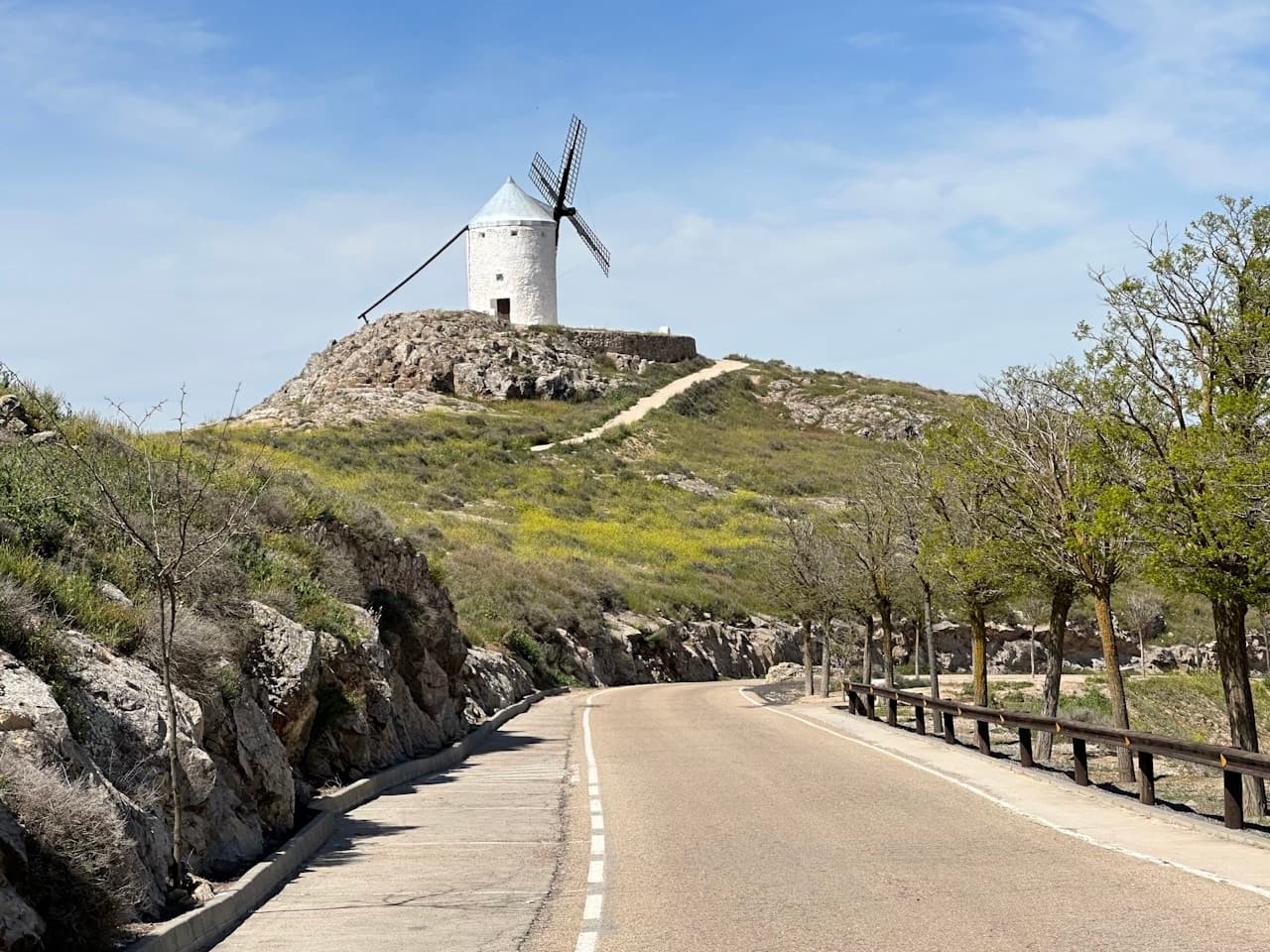
On his second sally, he recruits a neighboring farmer, Sancho Panza, as his squire by promising him an island to govern. What follows is a string of comic disasters. Don Quijote attacks windmills, thinking they're giants. He charges a flock of sheep, convinced it's an army. He frees a chain of convicted criminals. He mistakes country inns for enchanted castles.
The humor comes from the gap between what Don Quijote sees and what's actually there. But Cervantes isn't just making fun of his hero. He's asking a deeper question: is the man who refuses to accept a cruel reality truly insane, or is he the only sane person in the room?
Part 1 ends with Don Quijote's friends tricking him into a cage and carrying him home.
Part 2: The Deeper Novel (1615)
Part 2 is a different book. Cervantes published it ten years later, partly in response to a fake sequel written by someone using the pen name Avellaneda. In a move that was unprecedented in 1615, Don Quijote and Sancho discover that Part 1 has been published — they're characters who know they're in a book.
The comedy shifts from physical slapstick to psychological complexity. A duke and duchess, having read Part 1, decide to toy with Don Quijote by staging fake adventures. They give Sancho his promised "island" (Barataria) as a cruel joke. But Sancho governs wisely, showing more practical wisdom than any nobleman. When he realizes it's all a prank, he walks away with dignity.
Don Quijote, meanwhile, grows increasingly self-aware. After being defeated in Barcelona by a disguised neighbor, he renounces chivalry, returns home, and regains his sanity. He dictates his will, announces that he's no longer Don Quijote but simply Alonso Quixano, and dies. Sancho begs him to keep believing. He won't.
It's one of the most moving endings in world literature. And it hits even harder in Spanish.
Want a structured plan for building up to challenging texts? See our guide to your first 10 Spanish books.
What Key Vocabulary from Don Quijote Is Still Used in Modern Spanish?
Reading Don Quijote builds vocabulary that transfers directly to everyday conversation. Research shows learners need 95–98% lexical coverage for independent reading comprehension (Nation, Canadian Modern Language Review, 2006). The table below lists 15 terms from the novel that still appear in modern Spanish.
| Spanish | English | Modern Usage | Context in Don Quijote |
|---|---|---|---|
| caballero | knight / gentleman | Very common | Don Quijote's self-proclaimed title |
| escudero | squire | Literary/formal | Sancho's role — the faithful companion |
| locura | madness | Very common | The central theme: is Don Quijote mad or visionary? |
| molino | windmill / mill | Common | The giants that are actually windmills |
| aventura | adventure | Very common | Every misguided quest Don Quijote undertakes |
| encantamiento | enchantment / spell | Common | Don Quijote's explanation for everything that goes wrong |
| gobernador | governor | Very common | Sancho's role on the "island" of Barataria |
| ínsula | island (archaic) | Literary | Sancho's promised island — now means "hollow promise" |
| doncella | maiden | Formal/literary | The damsels Don Quijote tries to rescue |
| hazaña | feat / deed | Common | Every brave (or foolish) exploit |
| hidalgo | minor nobleman | Cultural term | Don Quijote's actual social class |
| sabio | wise person | Very common | The "wise enchanter" Don Quijote blames for his troubles |
| necio | fool | Common | An insult that appears constantly |
| refranero | proverb-lover | Uncommon | Sancho is famous for stringing proverbs together |
| quijotesco | quixotic | Common | Derived from the character — means "impractically idealistic" |
Phrases That Entered the Language
Several expressions from Don Quijote are still used in daily Spanish:
- Luchar contra molinos de viento — to fight windmills (tilting at impossible battles)
- Con la iglesia hemos topado — "we've run into the Church" (hitting an immovable institution)
- Ladran, Sancho, señal que cabalgamos — "they bark, Sancho, meaning we ride" (critics prove you're making progress). Often attributed to Cervantes, though it doesn't appear in the original text.
- Ser un Sancho Panza — being practical and down-to-earth
- Ser un Quijote — being an impractical dreamer
Still comparing methods? Here's why reading beats flashcards for Spanish.
Citation capsule: Learners need 95–98% lexical coverage for independent reading comprehension of a target-language text (Nation, Canadian Modern Language Review, 2006). Adapted versions of Don Quijote achieve this threshold at each CEFR level, while teaching culturally essential vocabulary like caballero, locura, and molino that remains in everyday use.
Ready to start reading?
Eppika adapts real bestsellers to your level — with tap-to-translate, audio narration, and vocabulary tracking built in.
Find My Reading LevelWhat Spanish Level Do You Need to Read Don Quijote?
You can start reading Don Quijote at A2 with the right adapted version. The original text is firmly C2 — a meta-analysis of vocabulary profiling found it uses over 22,000 unique word forms, far exceeding the 8,000–9,000 word families typical of C1 (Milton, Measuring Second Language Vocabulary Acquisition, 2009). Graded versions solve this by controlling vocabulary to match your level.
At A2 (Elementary), simplified versions retell the major episodes — windmills, Sancho's island, the death scene — in 2,000–4,000 words with controlled vocabulary. You won't get the full novel, but you'll understand the story and absorb the cultural references that every Spanish speaker knows.
At B1–B2 (Intermediate), adapted editions give you the real narrative arc across both parts. Modern spelling replaces archaic forms, and complex passages are simplified without losing Cervantes's voice. This is the sweet spot for most learners. You're reading a real novel, not just a summary.
At C1 (Advanced), lightly adapted versions preserve much of Cervantes's original prose and include selected unmodified chapters. You'll encounter the subjunctive used in ways textbooks never teach. The archaic vocabulary becomes a puzzle rather than a barrier.
At C2, read the full original. A good annotated edition like the one from the Real Academia Española (2015) provides glossary entries for obsolete terms. This is the version university courses use.
Looking for beginner-friendly books? See our best A1 Spanish books for beginners.
How Should You Read Don Quijote as a Spanish Learner?
Extensive reading produces an effect size of d=1.48 — significantly outperforming traditional instruction — according to a meta-analysis of graded reader studies (Nakanishi, TESOL Quarterly, 2015). A 2025 meta-analysis confirmed positive effects across vocabulary, reading, writing, fluency, and even speaking (Sangers et al., Educational Psychology Review, 2025). Here's a strategy tailored to Don Quijote.
Step 1: Read This Summary First
Knowing the plot before you start is not cheating — it's strategy. When your brain already knows what happens, it can focus on how Cervantes says it rather than what he's saying. Read the chapter summaries in this guide before opening the Spanish text.
Step 2: Start with Part 1's Famous Episodes
Don't try to read the entire novel from page one. Start with the most iconic scenes: the windmills (Chapter 8), Sancho's appointment as squire (Chapter 7), and the inn scene (Chapters 16–17). These episodes are self-contained, funny, and packed with high-frequency vocabulary.
Step 3: Use the 60% Comprehension Rule
If you understand less than 60% of a page, the version is too hard. Drop down a level. If you're above 95%, move up. The goal is comfortable challenge — enough unknown words to learn from context, not so many that you're guessing at every sentence.
Step 4: Track Recurring Vocabulary
Don Quijote repeats key words obsessively. Caballero, aventura, encantamiento, locura, and escudero appear dozens of times. This repetition is exactly what SLA research says builds vocabulary retention. Don't reach for the dictionary every time — let the repeated exposure do its work.
Step 5: Move to Part 2 After Finishing Part 1
Part 2 is a better novel but a harder read. The humor is subtler, the sentences are longer, and the metafictional elements require more cognitive effort. If you're at B1, you might read Part 1 in an adapted version and wait until B2 for Part 2.
Citation capsule: Extensive reading with graded texts outperforms traditional instruction methods by a wide margin (Nakanishi, TESOL Quarterly, 2015; Sangers et al., Educational Psychology Review, 2025). Reading adapted classics like Don Quijote at your CEFR level applies this research directly.
How Does Don Quijote Connect to Other Spanish Classics?
Don Quijote didn't appear in a vacuum. It built on and responded to the literature that came before it, especially the picaresque tradition launched by Lazarillo de Tormes in 1554. Understanding that lineage makes both books richer — and gives you a reading roadmap through Spanish literary history.
Cervantes knew Lazarillo. His novel directly parodies the chivalric romances that Lazarillo had already started undermining. Where the pícaro survives through street cunning, Don Quijote fails through delusional idealism. They're two sides of the same coin: what happens when you take Spain's social fantasies literally?
If you haven't read Lazarillo yet, it's shorter (roughly 15,000 words), funnier than you'd expect, and available at every CEFR level. We've written a full reading guide for Lazarillo de Tormes that follows the same format as this one.
Cervantes also wrote alongside the great dramatists of Spain's Siglo de Oro. If Don Quijote pulls you into 17th-century Spain, the natural companions are Lope de Vega's Fuenteovejuna — a fierce play about a village that rises against tyranny — and Calderón's La vida es sueño, the Golden Age's most famous meditation on free will, illusion, and what it means to be awake. Both work at B1 level in adapted form.
After Don Quijote, the natural next step is Cien años de soledad by García Márquez — Latin America's answer to Cervantes, and a novel that wouldn't exist without him. But that's a B2+ text. For a stepping stone into 19th-century Spanish realism, Galdós's Doña Perfecta takes Cervantes's clash between idealism and reality and transplants it to a small Spanish town. Build your way there.
Frequently Asked Questions
Is Don Quijote the First Modern Novel?
Most literary historians say yes. Published in 1605, Don Quijote introduced unreliable narration, character development across a long arc, and metafictional commentary — techniques that define the modern novel. With over 500 million copies sold, it's also the best-selling novel in history. The British literary journal The Guardian and the Norwegian Book Club both ranked it the greatest work of fiction ever written.
Can Beginners Read Don Quijote in Spanish?
Yes, with an adapted version. Simplified editions retell the major episodes in 2,000–4,000 words using A2 vocabulary and basic tenses. Research confirms learners need 95–98% lexical coverage for independent comprehension (Nation, 2006). Graded versions hit this threshold while preserving the windmills, Sancho, and the essential cultural references.
What's the Difference Between Part 1 and Part 2?
Part 1 (1605) is a comic adventure — slapstick, mistaken identities, physical humor. Part 2 (1615) is psychologically deeper: characters read their own book, the humor turns melancholic, and Don Quijote dies having regained his sanity. Most scholars consider Part 2 the superior work, but Part 1 is more accessible for language learners.
How Long Does It Take to Read Don Quijote in Spanish?
The full original runs about 380,000 words. At a B2 reading speed of roughly 150 words per minute, that's over 42 hours. An adapted Elementary version (2,000–4,000 words) takes 20–40 minutes. An Intermediate adaptation might take 3–5 hours. Start small and work up.
Should I Read Don Quijote Before or After Lazarillo de Tormes?
Read Lazarillo first. It's shorter (15,000–20,000 words versus 380,000), it established the picaresque genre that Cervantes responded to, and it builds the cultural vocabulary you'll need for Don Quijote. Think of Lazarillo as training wheels for Spanish literary classics. See our Lazarillo de Tormes reading guide for details.
Start Reading Don Quijote at Your Level
Don Quijote de la Mancha is the single most important novel in the Spanish language. Here's what to take away:
- You don't need C2 Spanish. Adapted versions exist from A2 through C1. Pick the one that matches your level and start reading.
- Learn the vocabulary that transfers. Words like caballero, locura, aventura, and molino aren't just literary — they show up in modern Spanish constantly.
- Read Part 1 first. It's funnier, more episodic, and more forgiving for language learners. Save Part 2 for when you're ready for deeper complexity.
- Build a reading ladder. Start with Lazarillo de Tormes, move to Don Quijote, then tackle García Márquez. Each book prepares you for the next.
Cervantes wrote Don Quijote over 400 years ago. It's been read by hundreds of millions of people in dozens of languages. But there's something irreplaceable about reading it — even a simplified version — in the language Cervantes used. That's where the real magic lives.
Read the adapted version of Don Quijote at your level on Eppika